
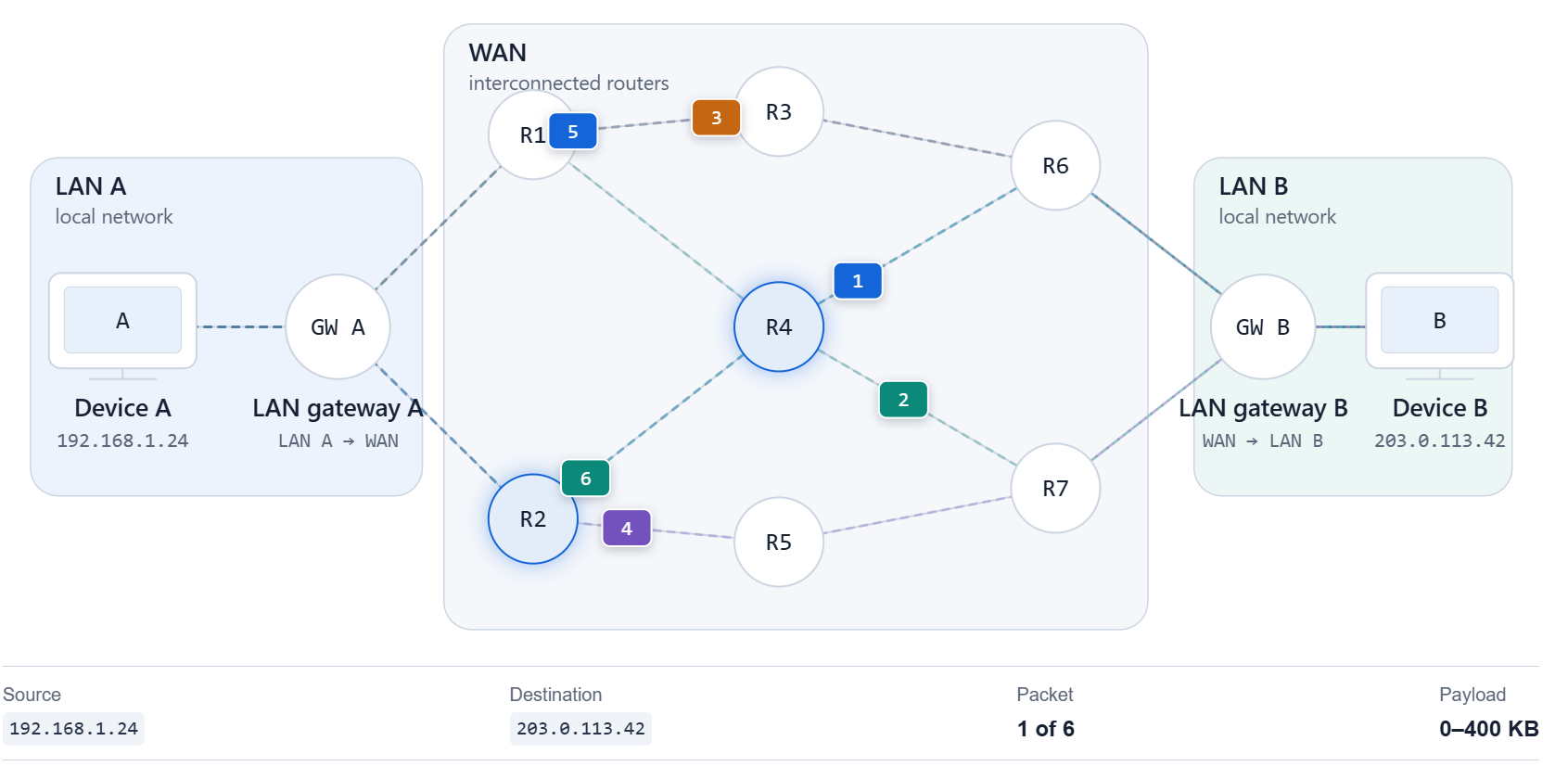
Data moves between devices on separate local area networks by splitting files into numbered packets. These packets travel through a local gateway and across wide area network routers. Each packet moves independently toward the destination gateway before reaching the final device on the receiving network.
The process uses TCP to divide and reassemble information, while IP addressing ensures packets reach the correct destination. Once every packet arrives, the receiving device verifies and reconstructs the original file. This sequence facilitates reliable data transmission across interconnected network infrastructures.
Packet journey
LAN A → gateways → WAN → LAN B
Device A · LAN A
192.168.1.24
Device B · LAN B 203.0.113.42
class-project.pdf2.4 MB
TCP
Ready
Press Send file to begin
0 of 6 arrived
Ready: two LANs connected by a WAN
Device A and Device B are each inside a local area network. Their LAN gateways provide the route to and from the WAN.
Source
192.168.1.24
Destination203.0.113.42
Packet—
Payload—
- TCPSplit + number
- IPAdd addresses
- Gateway ALeave LAN A
- WAN routersChoose next hops
- Gateway BEnter LAN B
- TCPCheck + rebuild
Leave a Reply